


How each program is structured
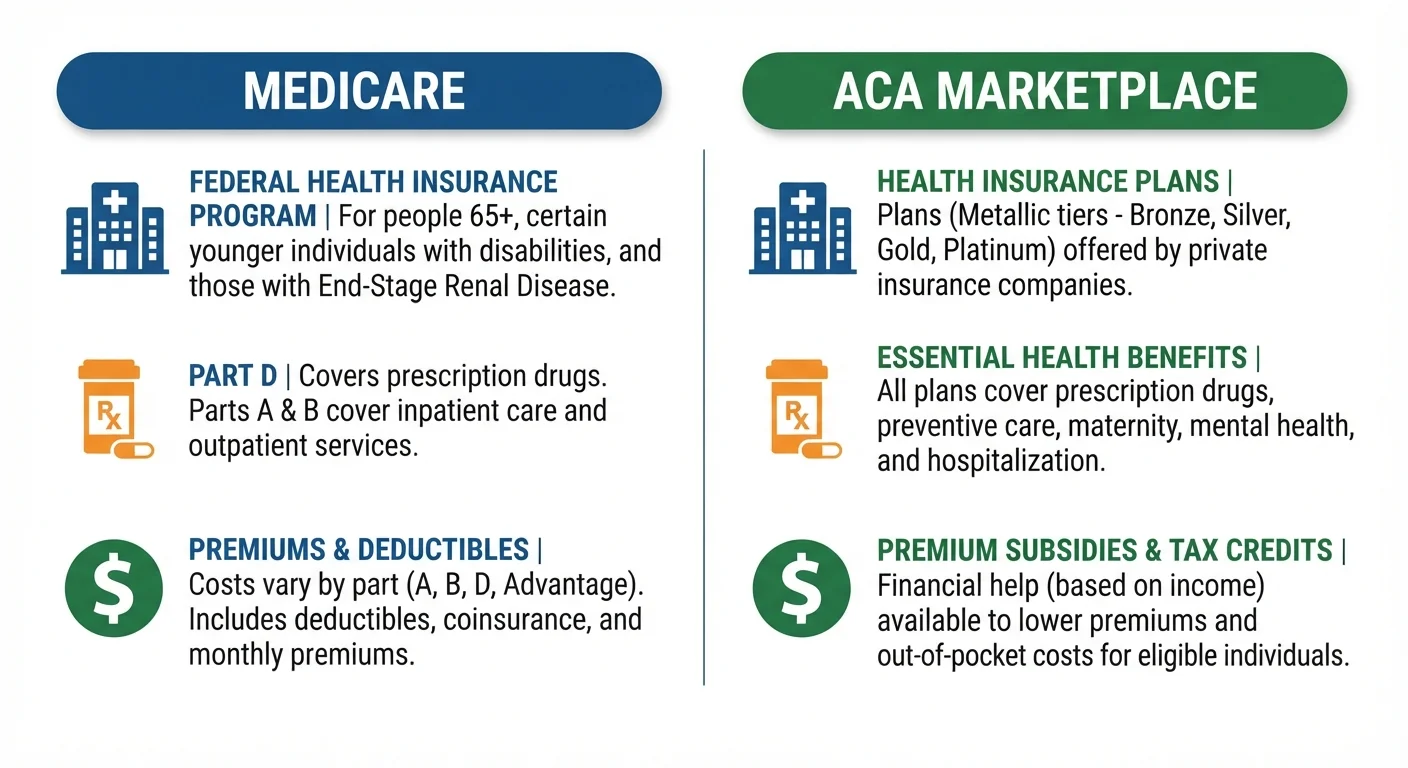
Medicare is a federal program with four main parts. Part A covers inpatient hospital stays and is premium-free for most people who paid Medicare taxes for at least 10 years. Part B covers outpatient care, including doctor visits and preventive services, and carries a monthly premium. Part C, known as Medicare Advantage, bundles Parts A and B through a private insurer and often includes drug coverage. Part D covers prescription drugs through standalone private plans.
ACA Marketplace coverage, sometimes called an Obamacare plan, is private insurance purchased through the federal exchange at HealthCare.gov or a state-run exchange. Plans are organized into metal tiers (Bronze, Silver, Gold, Platinum) that determine how costs are split between you and the insurer. Learn how each metal tier splits costs before choosing a plan. Eligible buyers can apply a premium tax credit based on their income to reduce monthly costs.
The enrollment timeline at 65
Medicare enrollment is time-sensitive. Your Initial Enrollment Period spans seven months: three months before your 65th birthday month, the birthday month itself, and three months after. Missing this window without qualifying coverage elsewhere triggers a late-enrollment penalty on Part B, which adds 10 percent to your premium for every 12-month period you went without coverage. That surcharge is permanent.
Understand how late penalties work before you decide to delay. If you have coverage through an employer with 20 or more employees, you may be able to delay Part B without penalty, but the rules depend on whether your employer coverage counts as creditable. Once that employer coverage ends, you have an eight-month Special Enrollment Period to sign up.
On the Marketplace side, open enrollment follows its own calendar, typically running from November 1 through January 15 for most states. Turning 65 and becoming Medicare-eligible does not automatically grant a Special Enrollment Period on the Marketplace; it triggers an obligation to leave.
SHIP counseling is free
Every state has a State Health Insurance Assistance Program that provides free, unbiased Medicare counseling. SHIP counselors can walk through your specific enrollment dates, explain how your current coverage affects your options, and help you avoid costly mistakes. You can find your state's SHIP contact through the Medicare.gov website.
Cost-sharing: what you actually pay
Both programs use deductibles, copays, and coinsurance, but the structures differ. Medicare Part A has a per-benefit-period deductible rather than an annual one. Part B has an annual deductible and then covers 80 percent of approved costs, leaving you responsible for 20 percent with no out-of-pocket cap unless you add a Medigap (Medicare Supplement) policy.
Marketplace plans have an annual out-of-pocket maximum, which limits your total exposure in a calendar year. That cap can be a meaningful protection for people with high medical costs. However, monthly premiums are only one part of what a plan costs. Network restrictions, formulary tiers, and referral requirements all affect what you actually spend.
Before committing to any plan, work through a checklist of personal health and financial factors that can clarify which structure fits your situation.
What happens if you stay on a Marketplace plan past 65
Once you are eligible for Medicare Part A, you generally lose the right to receive a premium tax credit on a Marketplace plan. The IRS treats Medicare eligibility as equivalent to having minimum essential coverage, so the subsidy stops even if you have not yet enrolled in Medicare. You would pay the full unsubsidized premium for the Marketplace plan, which is often substantially higher than Medicare Part B costs combined with a supplement.
There is no federal rule that prohibits buying a Marketplace plan after 65, but the financial logic changes sharply once the tax credit is gone. Medicare, paired with either a Medigap policy or a Medicare Advantage plan, is the more cost-effective path for most people in that situation. If your income or circumstances create an unusual scenario, a licensed insurance agent or your local SHIP counselor can model the actual numbers for your case.
This article is for general informational purposes only and is not personalized insurance, financial, or medical advice. Coverage terms, costs, and eligibility rules vary by plan and individual situation. Consult a licensed insurance professional or your State Health Insurance Assistance Program (SHIP) for guidance specific to your circumstances.