


What health insurance actually does
Health insurance is a contract between you and an insurer. You pay a regular premium to stay enrolled; in exchange, the insurer agrees to pay a share of covered medical costs. The catch is that most plans do not start sharing costs from the first dollar you spend. Several cost-sharing mechanisms determine exactly when the insurer steps in and how much it pays.
Understanding those mechanisms is the first step to comparing plans with any confidence. Without them, two plans that look similar on a summary can have very different effects on your annual spending. For a broader look at how plan structures shape your access to care, see our breakdown of HMO, PPO, EPO, and HDHP plan types.
This article is for general information only
The content here explains how health insurance concepts work in general. It is not personalized insurance or medical advice. Coverage terms, exclusions, and costs vary by plan and provider. Consult a licensed insurance agent or a qualified healthcare professional for guidance on your specific situation.
The four core cost-sharing terms
These four terms appear on every plan's Summary of Benefits and Coverage document. Each one describes a different slice of what you pay.
Premium
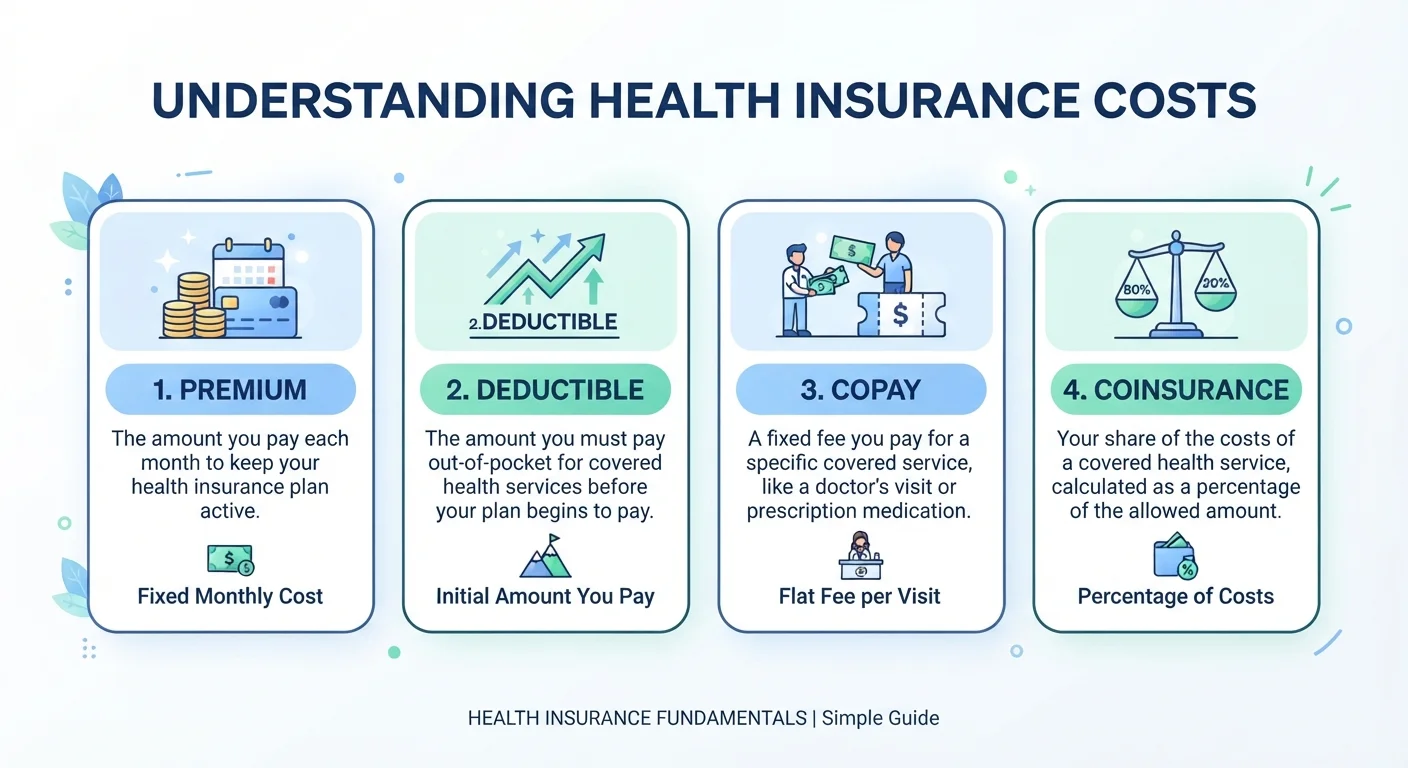
The fixed monthly amount you pay to keep your health insurance active, regardless of whether you use any medical services that month.
Deductible
The dollar amount you must pay out of your own pocket for covered services before your insurer starts sharing costs.
Copay
A set dollar amount you pay for a specific service, such as $30 for a primary care visit, usually due at the time of the appointment.
Coinsurance
Your share of a medical bill expressed as a percentage, paid after you have met your deductible. A 20% coinsurance means you pay 20% and the insurer pays 80%.
Out-of-pocket maximum
The most you will pay in a single plan year for covered in-network services. After reaching this limit, the insurer covers 100% of those costs.
Network
The set of doctors, hospitals, and other providers that have agreements with your insurer to provide care at pre-negotiated rates.
Formulary
The list of prescription drugs your plan covers, usually organized into tiers that determine your copay or coinsurance for each medication.
Actuarial value
A percentage that shows, on average, how much of covered medical costs a plan pays. A plan with 70% actuarial value covers roughly 70 cents of every covered dollar spent.
The interaction between these terms matters as much as each term alone. A low copay for a doctor visit does not help much if your deductible is $4,000 and applies before the copay does. For a deeper look at how deductibles, copays, and the out-of-pocket maximum interact over a plan year, see why the difference between these three terms matters.
Read the Summary of Benefits and Coverage
Every plan is required to provide a standardized Summary of Benefits and Coverage (SBC) document. It shows your deductible, out-of-pocket maximum, and cost-sharing for common services in plain language. Comparing SBCs side by side is one of the clearest ways to see real cost differences between plans.
How plan tiers affect your costs
Plans sold through the ACA marketplace are grouped into metal tiers: Bronze, Silver, Gold, and Platinum. The tier describes the average split of costs between you and the insurer, expressed as actuarial value. Bronze plans have an actuarial value around 60%, meaning the insurer covers roughly 60% of covered costs on average. Platinum plans sit near 90%.
A lower tier means a lower premium but higher cost-sharing when you use care. A higher tier means a higher premium but lower out-of-pocket costs at the time of service. Neither is universally better; the right fit depends on how much care you typically use and how your cash flow handles unexpected medical bills.
Silver plans have a separate consideration for lower-income enrollees: cost-sharing reduction (CSR) subsidies, when available, are applied only to Silver-tier plans. This can make Silver a more cost-effective tier for qualifying households even when the base premium looks higher than Bronze.
Networks, referrals, and why they matter
Every insurer negotiates rates with a set of providers. That group is your network. Using in-network providers means your insurer's negotiated rate applies, which directly lowers your share of the bill. Going out-of-network means you may pay the provider's full rate, often with no insurer contribution at all depending on your plan type.
Out-of-network costs can be substantial
Receiving care from a provider outside your plan's network can result in significantly higher bills, or in some plan types, no coverage at all. Before scheduling a procedure or seeing a specialist, confirm the provider's network status directly with your insurer, not just through the provider's office.
Referrals are a separate but related issue. Some plans require you to choose a primary care physician (PCP) who coordinates your care and issues referrals before you see a specialist. Others let you book specialist appointments directly. The plan type largely determines this: HMOs typically require referrals, while PPOs generally do not. For a full comparison of how each plan type handles networks and referrals, the plan type guide covers each structure in detail.
Where to go from here
Once you have these terms in hand, the next step is learning how to compare plans beyond the monthly premium. Network breadth, drug formularies, and cost-sharing caps often determine total annual cost more than the premium alone. Our guide on what to look at when comparing health plans walks through that process.
If you want a quick-reference list of terms, the health insurance glossary for early researchers covers more than 30 terms in plain language. And if you use a Health Savings Account alongside a high-deductible plan, the overview of tax-advantaged accounts explains how an HSA fits into your broader financial picture.
This article is for general informational purposes only and does not constitute personalized insurance, medical, or financial advice. Coverage terms, costs, and eligibility vary by plan and provider. Consult a licensed insurance agent or qualified professional for guidance specific to your situation.