


What each term actually means
The deductible is the dollar amount you pay for covered medical services before your insurance company begins contributing. If your deductible is $1,500, you pay the first $1,500 of eligible costs yourself each plan year. After that, cost-sharing between you and the insurer begins.
A copay (short for copayment) is a fixed fee you pay for a specific service, such as $30 for a primary care visit or $50 for a specialist. Some plans charge copays regardless of whether you have met your deductible. Others waive the copay until after you have. The plan documents spell out which applies.
The out-of-pocket maximum (sometimes called the out-of-pocket limit) is the most you will pay in covered, in-network cost-sharing during a single plan year. Once your deductible payments, copays, and coinsurance add up to that ceiling, your insurer covers 100% of additional covered in-network costs for the rest of the year.
For more on how these terms connect to the broader structure of a plan, see the plain-English guide to health coverage.
How the three terms interact
The relationship between these terms is sequential. You pay toward the deductible first. Once you cross that threshold, coinsurance (a percentage split, such as 80/20) typically kicks in. Your copays and coinsurance payments accumulate, and when the total hits your out-of-pocket maximum, your share drops to zero for the rest of the plan year.
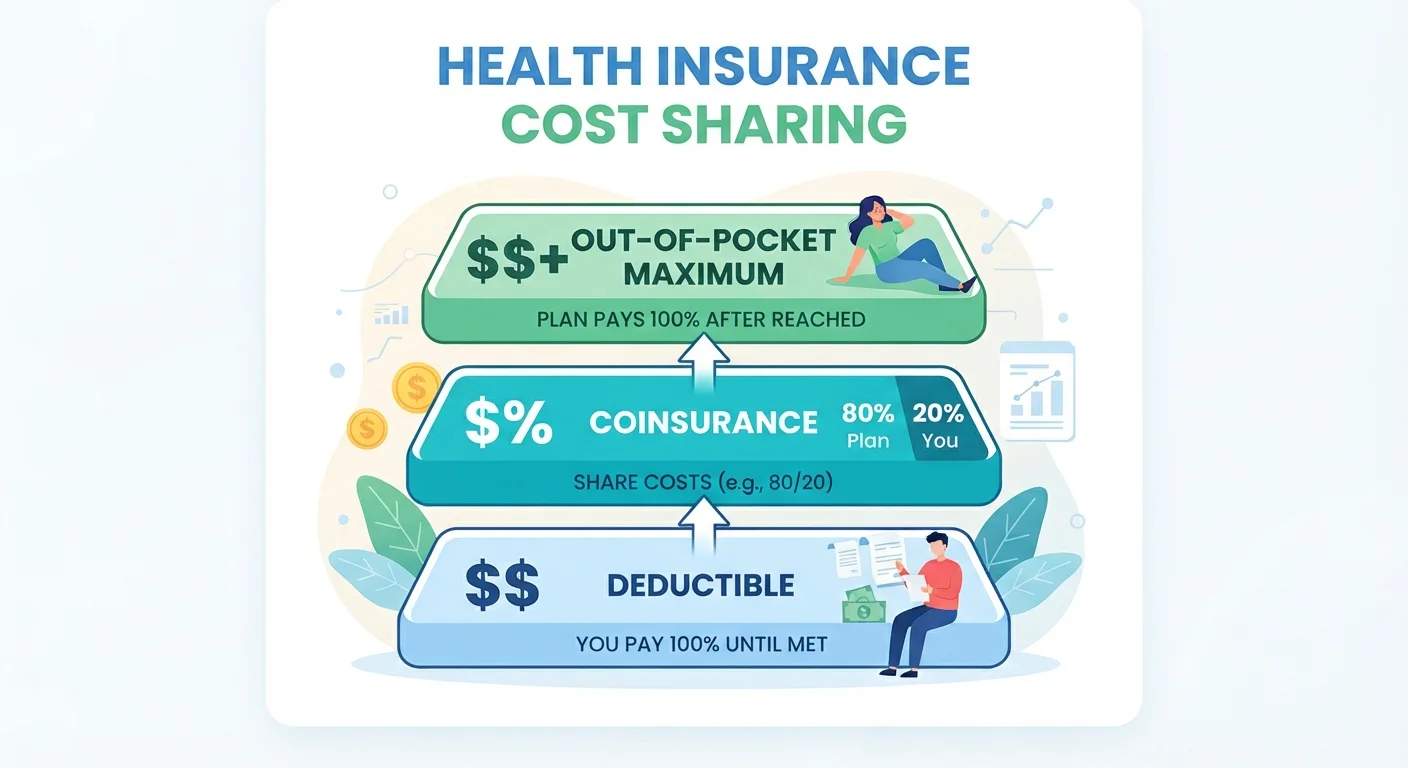
Consider a plan with a $1,500 deductible, 20% coinsurance after the deductible, and a $5,000 out-of-pocket maximum. A $10,000 hospital bill would work like this: you pay the first $1,500 (deductible), then 20% of the remaining $8,500, which is $1,700. Your total is $3,200, well below the $5,000 cap. If costs continued rising to push your total to $5,000, additional covered in-network expenses would cost you nothing for the remainder of the plan year.
Plans with lower premiums often carry higher deductibles. This tradeoff is examined in more detail in what to look at beyond the monthly premium.
$1,763
Average individual deductible, employer plans
According to the Kaiser Family Foundation 2023 Employer Health Benefits Survey, the average annual deductible for single coverage in employer-sponsored plans was $1,763.
$9,450
ACA out-of-pocket maximum, individual (2024)
The ACA sets annual caps on out-of-pocket costs for marketplace plans; for 2024, the limit for individual coverage was $9,450 for in-network services.
83%
Workers with a general annual deductible
The Kaiser Family Foundation 2023 survey found that 83% of covered workers in employer plans faced a general annual deductible.
Why this matters when comparing plans
A plan with a $200 monthly premium and a $6,000 deductible can cost more overall than a plan with a $350 premium and a $2,000 deductible, if you use significant care during the year. The premium savings of $1,800 annually do not offset a $4,000 difference in deductible exposure.
High-deductible health plans (HDHPs) are often paired with a Health Savings Account (HSA), which lets you set aside pre-tax dollars to cover qualified medical expenses. That tax advantage can partially offset the higher cost-sharing burden. Plan structures like HDHPs are covered in this breakdown of common plan types.
Seniors comparing Medicare supplement (Medigap) plans face a related set of tradeoffs, since Medigap policies are designed to cover some or all of Original Medicare's cost-sharing requirements. If you are approaching Medicare eligibility, be aware that late enrollment can trigger permanent premium surcharges.
This article is for general informational purposes only and is not personalized insurance or financial advice. Coverage terms, costs, and rules vary by plan and provider. Read your plan's Summary of Benefits and Coverage and consult a licensed insurance agent or advisor for guidance specific to your situation.