


Why the vocabulary matters before you compare plans
Health insurance shopping is hard to do well when the language itself is an obstacle. Words like "coinsurance," "formulary," and "actuarial value" appear on every plan summary, but few documents explain them clearly. This glossary gives you a working definition of the terms you will encounter most often, so you can read a Summary of Benefits and Coverage (SBC) without stopping to search every other phrase.
For a broader walk-through of how premiums, deductibles, and copays interact in practice, see Health Insurance Decoded. Once you have the vocabulary down, this breakdown of HMO, PPO, EPO, and HDHP plan types will help you match a plan structure to your situation.
This article is for general informational purposes only and is not a substitute for advice from a licensed insurance professional. Coverage terms, costs, and eligibility vary by plan and state.
Cost-sharing terms
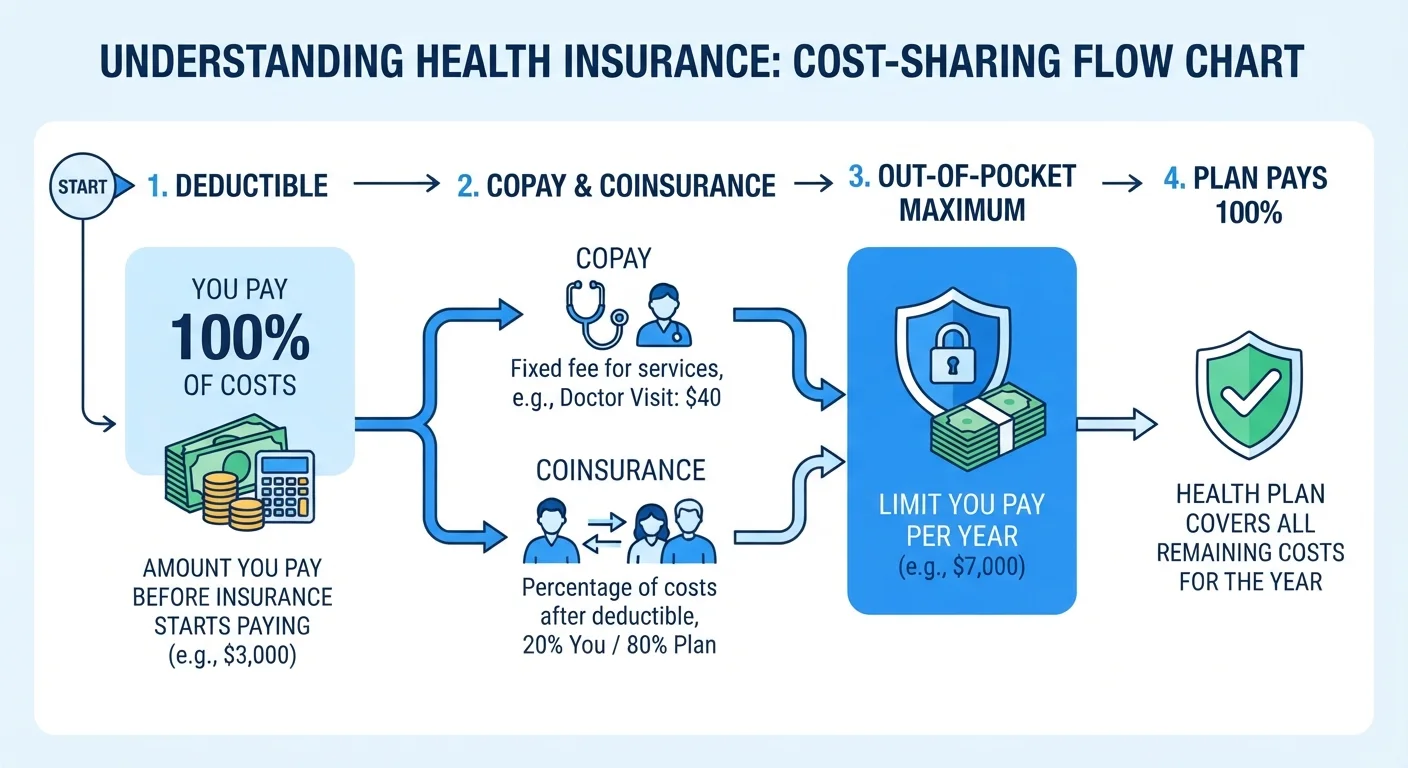
These terms describe how you and your insurer split the cost of care. Understanding all of them together is more useful than learning each one in isolation.
Premium: The fixed monthly amount you pay to keep your coverage active, regardless of whether you use any care that month.
Deductible: The amount you pay out of pocket for covered services before your insurer begins sharing costs. A $2,000 deductible means you pay the first $2,000 in covered expenses each plan year.
Copay: A flat dollar amount you pay for a specific service, such as $30 for a primary care visit, usually after your deductible is met (though some plans apply copays from day one).
Coinsurance: Your percentage share of costs after the deductible. If your coinsurance is 20%, you pay 20% of the allowed amount for a service and your insurer pays 80%.
Out-of-pocket maximum: The most you will pay in covered costs in a plan year. Once you reach this cap, the insurer covers 100% of covered in-network services for the rest of the year.
Allowed amount: The maximum your insurer will pay for a covered service. Providers in your network agree to this rate; out-of-network providers may charge more, and you typically absorb the difference.
| What resets annually | Deductible, out-of-pocket maximum, and most cost-sharing accumulators reset each plan year. |
| SBC requirement | Insurers are federally required to provide a Summary of Benefits and Coverage (SBC) in a standardized format. (ACA, 2010) |
| ACA metal tiers | Bronze (60% AV), Silver (70% AV), Gold (80% AV), Platinum (90% AV) (HealthCare.gov) |
| Out-of-pocket max (2025, ACA plans) | $9,200 for an individual; $18,400 for a family (HHS annual limits) |
| Open enrollment (federal marketplace) | Typically runs November 1 through January 15 each year for coverage starting the following January. (HealthCare.gov) |
Plan structure and network terms
Network: The group of doctors, hospitals, and other providers that have contracts with your insurer. Using in-network providers costs you less than going out of network.
Primary care physician (PCP): A general or family practice doctor who manages your routine care. HMO plans often require you to designate a PCP and get referrals through them before seeing specialists.
Referral: A written authorization from your PCP allowing you to see a specialist. Required by some plan types, not others.
Prior authorization (PA): Approval your insurer must grant before it will cover certain procedures, medications, or specialist visits. Without it, the claim may be denied even if the service is otherwise covered.
Formulary: Your plan's list of covered prescription drugs, organized into tiers that determine how much you pay. A drug not on the formulary is typically not covered at the standard rate.
Tiered network: Some plans divide in-network providers into tiers with different cost-sharing levels. Seeing a Tier 1 provider costs less than a Tier 2 provider, even though both are in-network.
Coverage and eligibility terms
Actuarial value (AV): The percentage of total covered costs a plan is expected to pay, on average, for a standard population. A plan with an 80% AV covers roughly 80 cents of every covered dollar spent; you cover the other 20 cents through deductibles, copays, and coinsurance.
Metal tier: The Affordable Care Act (ACA) marketplace groups plans into Bronze (roughly 60% AV), Silver (70%), Gold (80%), and Platinum (90%). Higher metal tiers generally mean higher premiums and lower out-of-pocket costs per service.
Open enrollment: The annual window when you can sign up for or switch health plans. Outside this period, you generally need a qualifying life event to change coverage.
Special enrollment period (SEP): A limited window to enroll or change plans triggered by events such as losing job-based coverage, getting married, or having a child.
Explanation of Benefits (EOB): A statement your insurer sends after a claim is processed. It shows what was billed, what the insurer paid, and what you owe. It is not a bill.
When you feel ready to move from definitions to decisions, work through this checklist of questions to answer before picking a health plan.
Actuarial value
The estimated percentage of covered medical costs a plan pays for an average enrollee. It does not predict your personal costs; it compares cost-sharing levels across plans.
Formulary
A list of prescription drugs covered by a health plan, grouped into cost tiers. Drugs not on the formulary may require prior authorization or a higher out-of-pocket payment.
Prior authorization
Advance approval from your insurer required for certain services or medications before they are covered. Skipping this step can result in a denied claim.
Out-of-pocket maximum
The annual cap on what you pay for covered in-network services. After reaching this amount, your insurer pays 100% of covered costs for the rest of the plan year.
Coinsurance
Your share of costs for a covered service after the deductible is met, expressed as a percentage. For example, 20% coinsurance means you pay one-fifth of the allowed amount.
Special enrollment period
A time-limited window outside open enrollment when you can sign up for or change health coverage after a qualifying life event such as losing other coverage or moving.
Allowed amount
The maximum an insurer will pay for a specific covered service. In-network providers agree to accept this rate; out-of-network providers may bill more.
Metal tier
A classification system used in ACA marketplace plans (Bronze, Silver, Gold, Platinum) that describes the plan's actuarial value and the general split of costs between the insurer and enrollee.