


Why financial vocabulary matters
When you apply for a loan, open a savings account, or compare credit cards, the terms in the fine print shape what you actually pay and what you actually receive. Misreading one word, such as confusing APR with APY, can lead to a choice that costs more than you expected. This glossary covers the terms Americans encounter most often across banking, borrowing, budgeting, and investing. It is general financial information, not personalized advice. For decisions specific to your situation, consult a licensed financial professional.
If you want to put these terms to work immediately, the building blocks of a personal budget article shows how concepts like net income and fixed expenses fit into a working spending plan.
Credit and borrowing terms
APR (Annual Percentage Rate) is the yearly cost of borrowing money, expressed as a percentage. It includes the interest rate plus most fees, so it gives a fuller picture of a loan's cost than the interest rate alone.
APY (Annual Percentage Yield) is the flip side: the rate you earn on savings or investments over a year, accounting for compounding. When comparing savings accounts, a higher APY means more money earned.
Amortization describes how a loan is paid off through scheduled payments over time. Each payment covers some interest and some principal. Early payments go mostly toward interest; later payments shift toward reducing the principal balance.
Principal is the original amount borrowed, separate from any interest owed on top of it.
Credit utilization is the share of your available revolving credit (such as credit card limits) that you are currently using. A lower ratio generally has a positive effect on credit scores.
Secured vs. unsecured debt: a secured loan is backed by collateral, meaning an asset the lender can claim if you default (a mortgage is secured by the home). An unsecured loan has no collateral and typically carries a higher interest rate because the lender takes on more risk.
APR
Annual Percentage Rate. The yearly cost of borrowing expressed as a percentage, including the interest rate and most lender fees. Use it to compare loan costs across products.
APY
Annual Percentage Yield. The rate earned on savings over a year, factoring in compounding. Higher APY means more interest earned on deposits.
Amortization
The process of paying off a loan through regular scheduled payments that cover both interest and principal. Each payment shifts the balance slightly toward paying down the original amount borrowed.
Liquidity
How easily and quickly an asset can be converted to cash without a significant loss in value. Checking and savings accounts are highly liquid; real estate is not.
Net worth
Total assets minus total liabilities. A snapshot of your financial position at a given point in time.
Credit utilization
The percentage of available revolving credit currently in use. It is calculated by dividing current balances by total credit limits.
Compound interest
Interest calculated on both the original principal and previously accumulated interest. It accelerates growth in savings and accelerates debt when balances remain unpaid.
Collateral
An asset pledged to a lender to secure a loan. If the borrower defaults, the lender may seize the collateral to recover the outstanding balance.
Assets, net worth, and liquidity
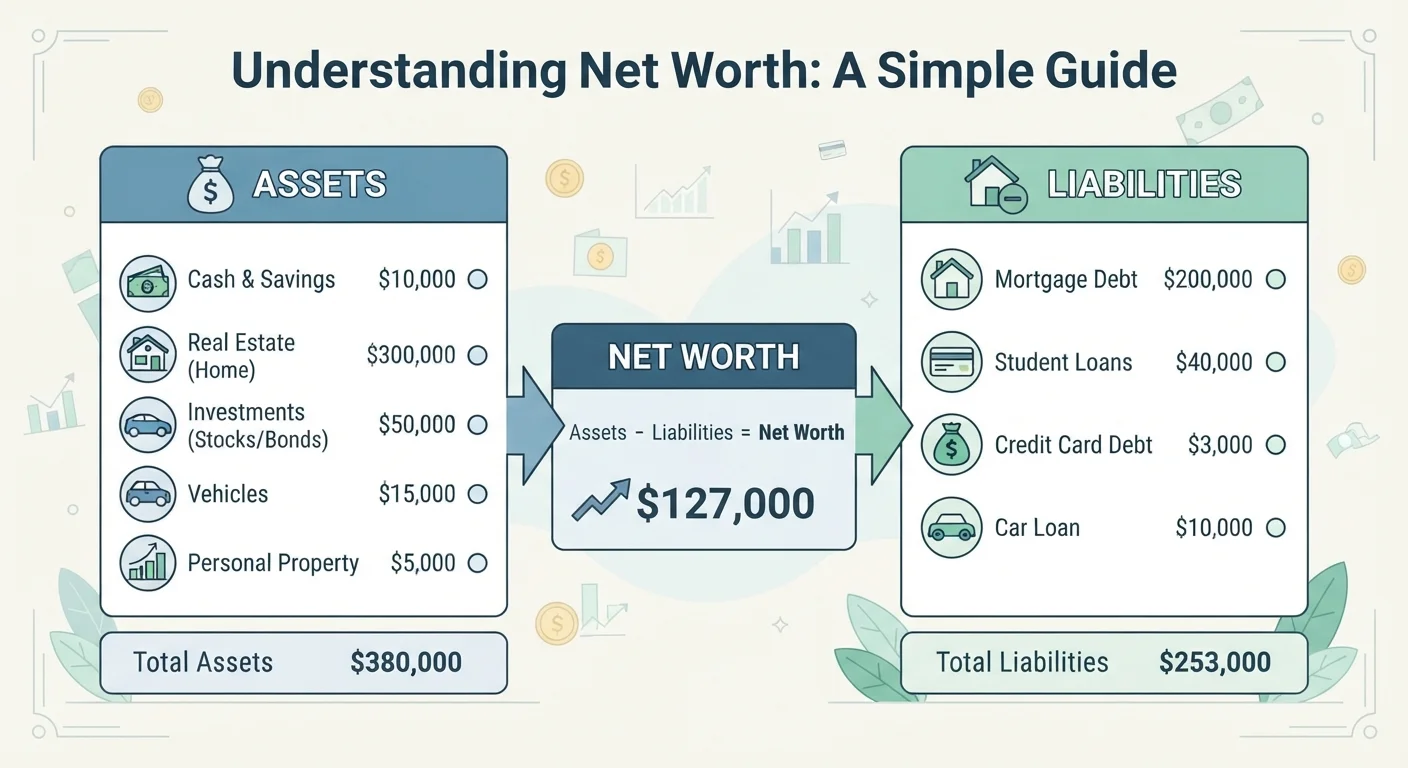
Asset is anything you own that has financial value: a checking account balance, a car, a home, or an investment account.
Liability is money you owe: a car loan, a mortgage, a credit card balance, or a student loan.
Net worth is assets minus liabilities. A positive number means you own more than you owe. For a deeper look at what that figure tells you over time, see net worth explained.
Liquidity refers to how quickly and easily an asset converts to cash without losing significant value. A savings account is highly liquid. A house is not, because selling it takes time and costs money.
Emergency fund is money set aside in a liquid account to cover unexpected expenses, such as a medical bill or job loss, without taking on new debt.
| APR vs. APY | APR measures borrowing cost; APY measures savings earnings |
| Net worth formula | Total assets minus total liabilities |
| Emergency fund target (general guidance) | Three to six months of living expenses in a liquid account |
| Credit utilization and scores | Lower utilization generally has a positive effect on credit scores |
| Gross vs. net income | Gross is before deductions; net is take-home pay |
Income, taxes, and everyday budgeting
Gross income is total earnings before any deductions, such as taxes or retirement contributions, are removed.
Net income (sometimes called take-home pay) is what remains after all deductions. Budgets are built around net income because that is the money actually available to spend.
Withholding is the portion of your paycheck your employer sends directly to the IRS on your behalf. If too little is withheld, you may owe taxes at filing time. If too much is withheld, you receive a refund.
Deductible (tax context) is an expense the IRS allows you to subtract from taxable income, which lowers the amount of income that is taxed. This is different from a deductible in insurance, where it is the amount you pay out of pocket before coverage starts. The health insurance decoded guide explains the insurance version in detail.
Compound interest is interest calculated on both the original principal and the interest already accumulated. Over time, this accelerates growth in savings accounts and, in the opposite direction, accelerates debt growth when balances go unpaid.
This article is for informational purposes only and does not constitute personalized financial, investment, tax, or legal advice. Consult a licensed financial professional before making decisions based on your individual circumstances.