


How the two structures work
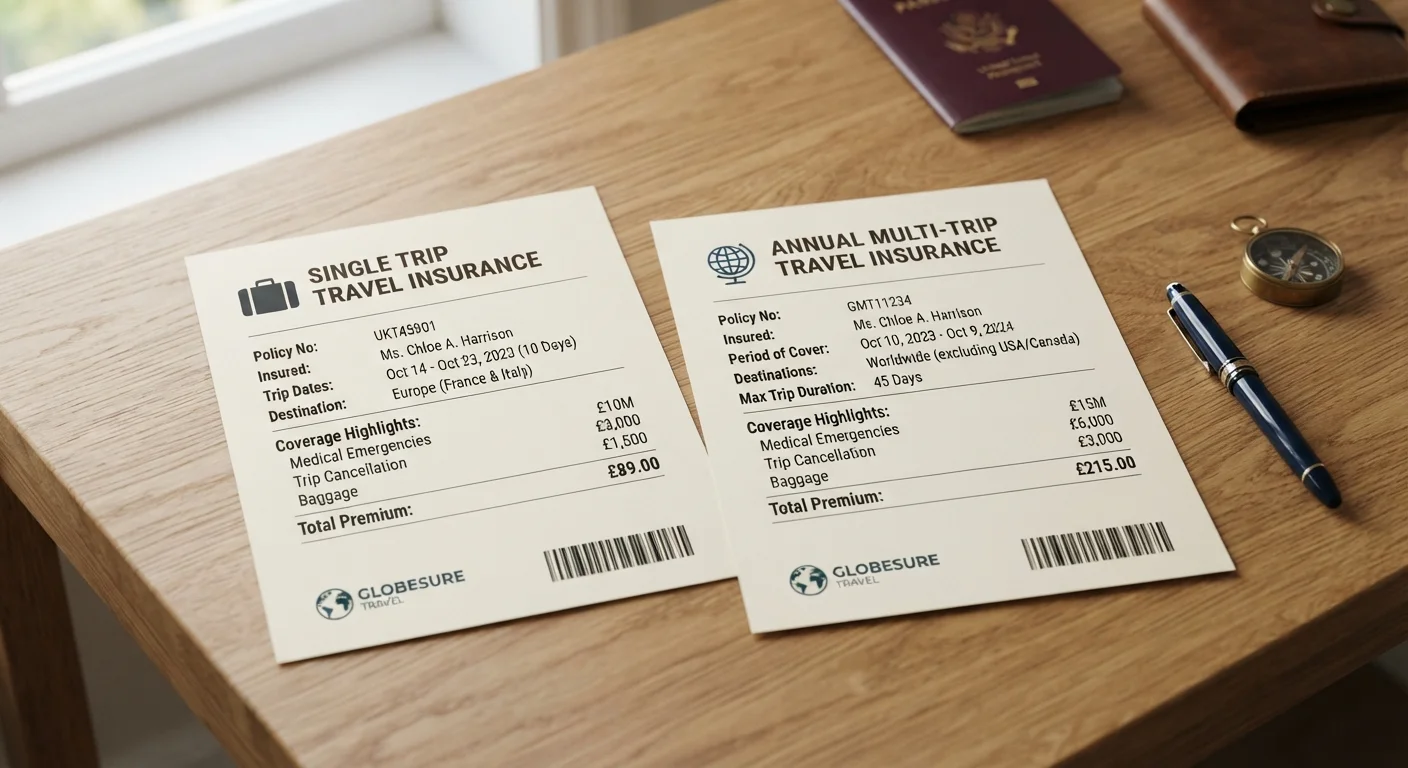
A single-trip policy attaches to one specific journey. You buy it before departure, it activates when you leave home, and it ends when you return. The insurer prices it based on your destination, trip length, traveler age, and the total trip cost you want to protect.
An annual multi-trip policy, sometimes called a multi-trip plan, covers an unlimited number of trips within a 12-month period. You pay one premium at the start of the year. Each time you travel, coverage automatically applies without buying a new policy, as long as the trip meets the plan's conditions.
The core trade-off is flexibility versus simplicity. Single-trip coverage can be tailored precisely to one journey. Annual coverage removes the step of buying insurance before each trip, which some travelers find useful when plans come together quickly.
For a plain explanation of terms like trip interruption, cancel-for-any-reason, and primary versus secondary medical coverage, see this glossary of travel insurance terms.
Where the structures differ most
| Feature | Single-trip policy | Annual multi-trip policy | |
|---|---|---|---|
| Coverage period | One trip, departure to return | 12 months, multiple trips | |
| Per-trip duration limit | Set per policy, can exceed 90 days | Typically 30 to 60 days per trip | |
| Trip cancellation coverage | Usually included | Varies; may be add-on | |
| Pre-existing condition waiver | Tied to deposit date for that trip | Often tied to first trip deposit of year | |
| Best for trip frequency | One to two trips per year | Three or more trips per year | |
| International medical limits | Customizable per trip | Varies; confirm before travel | |
| Cost structure | Per-trip premium | Single annual premium |
The biggest practical difference between the two structures is the per-trip duration limit on annual plans. Most annual policies allow each individual trip to last between 30 and 60 days. A trip longer than that maximum is typically excluded or requires an upgrade. Single-trip policies can be written for journeys of 90 days or more, making them the more practical option for extended travel.
Coverage for pre-existing medical conditions varies by policy type and provider. Some annual plans include a pre-existing condition waiver if you buy the policy within a set window, often 14 to 21 days, after your first trip deposit of the year. Single-trip policies may offer the same waiver tied to the purchase date relative to the initial deposit for that specific trip. Conditions and timelines differ across insurers, so reading the policy document matters.
Destination restrictions also appear on some annual plans. A policy sold as a domestic annual plan may exclude international travel entirely, or it may cover international trips at a lower medical limit than a single-trip international policy would. Travelers going abroad should confirm whether the annual plan's medical coverage is adequate for their destination. For more on that distinction, see domestic vs. international travel insurance differences.
Cost comparison across trip frequency
There is no universal price point for either structure. Premiums depend on traveler age, health history, destination, trip cost, and the coverage limits you select. That said, a general pattern holds: if you take one or two trips a year and each involves a significant prepaid cost, a single-trip policy priced to cover that specific cost is often the straightforward option. You pay for what you need and nothing more.
When trip frequency rises, the math can shift. Buying three or four separate single-trip policies in a year adds up in both cost and administrative effort. An annual plan with a single premium may come out lower in total, though that depends on what each trip costs and how much coverage each single-trip policy would have required.
One factor often overlooked: annual plans do not always include trip cancellation or trip cost protection by default. Some are structured primarily around medical and evacuation coverage, with optional add-ons for cancellation. Before comparing prices, confirm what each policy actually covers rather than assuming both structures provide identical benefits.
Check the per-trip cap before you buy
Annual plans almost always include a maximum number of days per individual trip. If any single trip runs longer than that cap, you will need a separate policy for the overage or for the entire trip. Confirm the cap before purchasing an annual plan, especially if you take any extended journeys.
Older travelers and those with health conditions should pay particular attention to medical evacuation limits and pre-existing condition language. The senior travel planning guide covers insurance considerations alongside budgeting and accessibility factors.
Situations where each structure fits better
Single-trip policies fit well when the trip is expensive, long, or involves a destination with high medical costs. If you prepay a large cruise or an international tour and you want cancellation protection tied to that specific booking, a single-trip policy lets you set the covered trip cost precisely.
Annual plans fit well when travel is frequent and trips are shorter. A traveler who flies domestically several times a year for a mix of personal and family reasons, and occasionally adds a short international trip, may find an annual plan practical. The convenience of automatic coverage without repeated purchasing is real, and the per-trip cost can be lower.
Travelers who are uncertain about how often they will actually travel in a given year should be cautious about committing to an annual premium. If plans change and trips do not materialize, the cost savings disappear. Annual plans are not refundable mid-term in most cases, so the value depends on actually using them.
This article is for general informational purposes only and does not constitute insurance, financial, or legal advice. Coverage terms, exclusions, pricing, and availability vary by provider and by state. Read any policy document carefully and consult a licensed insurance agent or adviser before making coverage decisions.